


Somebody typed “50 cent net worth” into Google about four minutes ago. Somebody else just searched “is Dolly Parton a billionaire.” Multiply that by every hour of every day, across a few hundred names, and you get a genuinely enormous stream of curiosity that most of the internet answers badly, with recycled numbers from 2019, wild guesses dressed up as facts, or a figure some blog invented and every other blog copied without checking.
That’s the gap influencersnetworth.com exists to close.
I built this site because I kept running into the same problem researching content for other projects: ask five different sites what Steve Harvey is worth and you’ll get five different answers, often with no explanation of where the number came from. One site says $200 million. Another says $160 million. Neither links a source. That’s not journalism, that’s a rumor with a dollar sign attached to it.
What This Site Actually Does
Influencers Net Worth tracks the financial lives of people the public is curious about, musicians, actors, YouTubers, TikTok stars, streamers, podcasters, comedians, athletes, and the entrepreneurs who built empires most people only vaguely know about. For each person, we’re not just slapping a number on a page. We’re trying to answer the questions that actually sit behind the search: How did they make it? Is the number going up or down? Does “worth $50 million” mean they have $50 million sitting in a bank account (it almost never does), or does it mean the value of everything they own minus what they owe?
That last distinction matters more than most readers realize, and almost nobody explains it. Net worth is a snapshot, not a paycheck. It bundles together things like real estate equity, business ownership stakes, royalty streams, brand valuations, stock holdings, and cash, then subtracts debt. A rapper who owns a catalog worth $30 million and a house worth $8 million but carries $5 million in loans has a net worth of $33 million even if his checking account has four figures in it. People confuse net worth with income constantly, and honestly, so did I before I started digging into how outlets like Forbes and Bloomberg actually build these estimates.
The site launches with five core coverage categories, visible right in the navigation:
- Entrepreneurs & Podcasters, business builders, media moguls, and the voices behind the shows reshaping how people get news and opinion
- Gamers & Streamers, the Twitch and YouTube gaming economy, where subscription revenue and sponsorship deals have quietly created a new class of millionaire
- Lifestyle & Beauty, founders and creators who’ve turned personal brand into product lines, from makeup to home goods
- TikTok Stars, the fastest-growing and least-understood income bracket in the creator world
- YouTubers, still the platform with the clearest, most trackable revenue model, and still wildly misunderstood by outsiders
Alongside those five, a large share of what we cover, musicians, actors, comedians, athletes, TV personalities, falls under a broader entertainment umbrella that spans decades of Hollywood, music industry, and sports economics. Think Dolly Parton next to Duke Dennis. Different eras, different revenue models, same basic question: what’s actually going on with their money?
Why Net Worth Content Deserves Better Than It Gets
Here’s an opinion I’ll happily defend: most net worth journalism online is lazy. Not all of it, Forbes and Bloomberg do real financial modeling, pulling from SEC filings, real estate records, royalty statements, and industry-standard valuation multiples. But the layer of sites sitting underneath them, the ones that show up in the search results next to the big names, mostly just paraphrase whatever number ranked first last year and update the “as of” date. Nobody explains the assumptions. Nobody flags when estimates from different outlets disagree by tens of millions of dollars. Nobody revisits a figure after a major life event, a divorce, a bankruptcy, a business sale, until months later, if at all.
Take Dolly Parton. When she passed, Forbes pegged her estate at roughly $450 million. Celebrity Net Worth put it closer to $650 million. That’s a $200 million gap between two outlets that both claim rigorous methodology, and it comes down to how each one values her music catalog, her real estate, and her business stakes like Dollywood. A reader who lands on just one of those numbers walks away thinking it’s settled fact. It isn’t. It’s an estimate, built on assumptions, and the honest thing to do is say so.
That’s the standard we’re building toward here. Where estimates diverge across major sources, we’ll say so instead of picking whichever number sounds most dramatic. Where a figure is genuinely unclear, private companies don’t file public earnings reports, and plenty of these people run private companies, we’ll say that too, instead of pretending precision we don’t have.
The Creator Economy Is Bigger Than Most People Realize (And Nobody Agrees on the Number)
Quick detour into why this whole niche has exploded. Estimates on the size of the global creator economy vary wildly depending on who’s counting and what they’re counting, everything from $203 billion to over $310 billion for 2026 alone, depending on the research firm, with some projections pushing past a trillion dollars by the early 2030s. Even the “conservative” numbers put well over 200 million people worldwide identifying as some kind of content creator.
I’ll be honest: I don’t fully trust any single one of those figures, because the methodologies differ so much between reports that comparing them is a bit like comparing apples to a spreadsheet. But the direction is unmistakable. Brand deals still account for the majority of creator revenue, somewhere around 70% by most counts, while platform payouts, affiliate income, and owned product lines make up the rest.
And the income gap inside that economy is brutal: roughly half of creators earn under $15,000 a year, while a small sliver clears six or seven figures. That gap is exactly why “how much does this person actually make” is such a persistently popular search. People aren’t just curious about celebrities anymore. They’re trying to understand a career path that didn’t exist fifteen years ago, one where a 22-year-old with a ring light can out-earn a mid-tier actor, and a musician’s TikTok virality can matter more than a record deal.
How We Build Our Net Worth Estimates
No site, ours included, has a subpoena. We can’t see anyone’s actual bank statements, and anyone claiming otherwise is either lying or has access nobody else does. What we do instead is triangulate from public, checkable sources:
Known salaries and contract terms, when they’ve been reported by credible outlets or disclosed in public filings. Real estate transactions, which are public record in most U.S. counties and internationally in many other jurisdictions. Business ownership stakes and company valuations, where available. Endorsement and brand deal reporting from trade publications like Billboard, Variety, and industry-specific outlets.
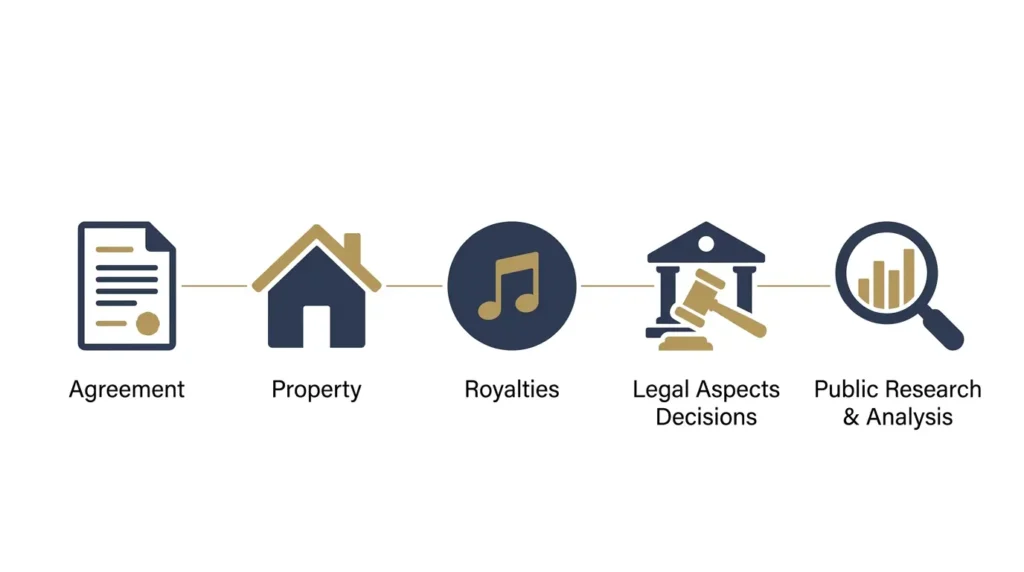
Streaming and royalty data, particularly for musicians, where platforms like Spotify and services like Luminate publish enough aggregate data to model reasonable royalty ranges. Court records, for divorces, lawsuits, and bankruptcy filings, which occasionally reveal financial details that would otherwise stay private. And, where relevant, published estimates from established financial outlets like Forbes and Bloomberg, which we treat as a data point to weigh against our own research, not as gospel to copy.
Every article states how a figure was derived and how current it is. We revisit numbers after major events instead of letting them sit stale for years. And when we genuinely don’t know, when a person’s finances are opaque enough that any number would be closer to a guess than an estimate, we’d rather tell you that than invent false precision.
One thing I try to avoid, and this took some trial and error to figure out: rounding to whatever number sounds cleanest. It’s tempting to write “$500 million” because it reads better than “$487 million,” but if the underlying research points to $487 million, that’s what goes in the article. Clean numbers are usually a sign somebody didn’t do the math.
Who’s Covered First, and Why
The initial slate of 100+ profiles spans a genuinely wide range, on purpose. You’ll find music legends whose wealth was built over five decades (Dolly Parton, Diana Ross, Reba McEntire) sitting next to creators who built theirs in five years (Ryan Trahan, Jack Doherty, CaseOh). You’ll find political figures whose net worth curiosity spikes around election cycles (Zohran Mamdani, Marjorie Taylor Greene, Charlie Kirk) next to Shark Tank investors whose whole public identity is built around money (Kevin O’Leary, Barbara Corcoran, Lori Greiner).
That range isn’t random. It maps to where search demand actually lives. Rap and hip-hop artists, 50 Cent, Nicki Minaj, ASAP Rocky, Megan Thee Stallion, Fat Joe, Kodak Black, NBA YoungBoy, represent one of the highest-volume, most consistently searched corners of celebrity finance, partly because hip-hop culture has always been unusually open about discussing money as a marker of success.
Late-night and talk-show hosts (Jimmy Kimmel, Steve Harvey, Kelly Ripa, Howard Stern) pull consistent search interest because their financial lives get discussed on-air constantly, which primes curiosity. And the streaming and TikTok names, Duke Dennis, Baylen Dupree, Damon Darling, Druski, represent a search category that barely existed a decade ago and is still catching up in terms of quality coverage.
A few names on the list sit at genuinely fascinating intersections. Chip and Joanna Gaines built a media and home-goods empire that’s part lifestyle brand, part TV franchise, part retail business, hard to categorize, easy to be curious about. Mike Lindell’s finances have been publicly and repeatedly scrutinized in ways most CEOs never experience. Wendy Williams’ financial situation involves a court-appointed guardianship, which makes “what is her net worth” a genuinely more complicated question than it looks on the surface, and one we plan to handle with the care it deserves rather than a flippant number.
A Word on Estimates, Privacy, and Why We’re Not in the Business of Doxxing Anyone
Net worth journalism sits in a slightly odd ethical space. These are, for the most part, public figures who’ve chosen careers built on visibility, musicians, actors, athletes, YouTubers who film their own lives for a living. Discussing the broad shape of their finances, using public information, is standard business and entertainment journalism, the same category Forbes, Bloomberg, and Billboard operate in every day.
That said, there’s a line, and I want to be upfront about where we draw it. We don’t publish home addresses, account numbers, or anything that could function as a roadmap to someone’s physical security. We don’t speculate about private family finances that have no public source behind them. And for people going through something genuinely difficult, a public divorce, a health crisis, a legal battle, we try to write about the financial angle without turning the article into rubbernecking. There’s a difference between “here’s what public records show about the settlement” and “here’s a breathless play-by-play of someone’s worst year,” and we’re aiming for the former.
What Makes a Net Worth Article Actually Useful
Most articles in this niche follow an identical, tired formula: a one-line answer, a short and generic bio, a bulleted list of “income sources” with no numbers attached, and a conclusion that just restates the headline. Readers scan it in eight seconds and learn nothing they didn’t already know from the title.
We’re structuring our content differently, and it comes down to a few things I think this niche gets wrong constantly:
We separate net worth from income, every time. These are different numbers and conflating them is the single most common error in this space. Someone can have a modest net worth but massive current income (early-career creators, for instance), or a huge net worth but currently modest income (someone living off a catalog they built decades ago).
We show the math, or as much of it as public information allows. If someone’s wealth breaks down roughly as $12 million in real estate, $8 million in a business stake, and $5 million in liquid assets against $3 million in debt, we’ll say that, instead of just handing over a single flattened number.
We track direction, not just position. Is this person’s wealth growing, shrinking, or flat? A career trajectory tells a more interesting and more useful story than a static figure ever could.
We update. A net worth page frozen in 2023 is worse than useless in 2026, it’s actively misleading. Every profile on this site carries a clear “last updated” marker, and we revisit figures after major financial events rather than letting them fossilize.
We source everything we can. Where a number comes from Forbes, we say so and link it. Where it comes from our own research across public records, we explain the method. Readers deserve to know the difference between “here’s a documented figure” and “here’s our best estimate.”
Frequently Asked Questions
How accurate are celebrity net worth estimates, really?
Honestly? They’re estimates, not audited financial statements, and anyone presenting them as exact figures is overselling their own precision. Even Forbes and Bloomberg, with real analysts and real methodology, land on different numbers for the same person because private company valuations and asset appraisals involve judgment calls. Treat every net worth figure, ours included, as a well-researched range compressed into a single headline number, not a bank statement.
Why do different sites report different numbers for the same celebrity?
Different sources weigh assets differently. One outlet might value a music catalog at a higher multiple than another. One might count a business stake at its last funding valuation while another discounts it for illiquidity. Divorce settlements, recent asset sales, and undisclosed debt can all shift a number that a competing site simply hasn’t updated yet.
Does net worth include debt?
Yes, always, or at least it should. Net worth means assets minus liabilities. A person with $40 million in property and $15 million in mortgages and business loans has a net worth of $25 million, not $40 million. Sites that skip this step and just add up gross assets are inflating the number, whether they realize it or not.
How often do you update net worth figures on this site?
Our goal is to revisit every profile at least annually, and sooner for anyone going through a major financial event, a business sale, a divorce settlement, a bankruptcy, a big new contract. Each article carries a visible update date so you know exactly how fresh the figure is.
Are these figures the same as what a person actually has in cash?
Almost never. Most high-net-worth individuals hold the bulk of their wealth in illiquid or semi-liquid assets: real estate, business equity, stock, royalty rights. Cash on hand is typically a small slice of total net worth.
Where do you get your information?
Public records (real estate transactions, court filings), reported salaries and contract terms from credible trade and news outlets, published estimates from established financial media like Forbes and Bloomberg, and industry-standard data sources for things like music royalties and streaming revenue. We cross-reference rather than relying on a single source.
Do you cover people who aren’t traditionally “celebrities”?
Yes, deliberately. Entrepreneurs, podcasters, streamers, and TikTok creators don’t fit the old-school Hollywood mold, but they’re some of the most-searched net worth queries online today, and their financial stories, often built in a fraction of the time it took previous generations of celebrities, are genuinely interesting.
Where This Site Is Headed
This introductory piece marks the starting line, not the finish line. Over the coming months, the plan is to build out full profiles across all five core categories, cross-link related figures (music-industry peers, YouTube collaborators, Shark Tank co-investors), and layer in comparison content, net worth rankings by category, by decade, by platform, that goes beyond the single-name search and helps readers understand the bigger picture of how wealth gets built in entertainment, sports, and the creator economy.
We’ll also be transparent about corrections. If a figure turns out to be wrong, or new information changes the picture, the article gets updated and the change gets noted. That’s not a weakness in the coverage. That’s what taking the subject seriously actually looks like.
If you’ve landed here because you searched a specific name, 50 Cent, Taylor Swift, LeBron James, whoever brought you in, welcome. The individual profile is probably a click away, or coming soon if it isn’t live yet. And if you’re just curious about how any of this works, now you know: real sources, honest uncertainty where it exists, and numbers we’re willing to explain rather than just declare.


-
-
-
-
-
-
-
-
-
-
-
-
-
-
-
Show Comments[…] She also partnered with nail care brand Mented Cosmetics and various high-end fashion houses for targeted social media campaigns. Her Instagram following, which exceeds 15 million highly engaged users, allows her to command premium rates for sponsored deliverables. Standard influencer pricing models suggest she can charge upwards of $50,000 to $100,000 per dedicated promotional post. For an overview of creator monetization strategies, visit influencers net worth. […]
[…] business models. For further analysis on creator valuations, review the detailed profiles at Influencers Net Worth. The path to eight-figure wealth in comedy no longer demands a prime-time […]
[…] His live performance income fully financed the acquisition and maintenance of his famous vehicle collection. By restricting his spending to this secondary income stream, he naturally capped his lifestyle inflation. If he wanted to purchase a rare supercar, he simply had to book enough live shows to cover the acquisition cost. For more insights on creator wealth and similar portfolios, check out the profiles on influencers net worth. […]
[…] However, the true financial power of YouTube lies in its function as a discovery engine. The platform’s algorithm constantly serves short, viral clips to new audiences. These clips act as unpaid advertisements for the live tours and merchandise stores. The direct ad revenue is substantial, but the indirect value of YouTube as a customer acquisition tool is exponentially higher. This dual-purpose mechanism is a hallmark of the most successful digital media businesses. For a broader context on creator wealth strategies, explore our index on influencers net worth. […]
[…] his 1980s peers reveals the diverse financial outcomes of child stardom. Readers investigating influencers net worth frequently spot massive disparities among actors from the exact same […]
[…] entertainment standards. You can examine wider industry earnings benchmarks through detailed influencers net worth comparative data. Wealth accumulation for family entertainment brands compounds rapidly because […]
[…] Growth curves in the creator economy rarely move in straight lines. Wealth accumulation typically spikes following major viral moments or successful product launches. His strategic association with other high-profile creators accelerated this wealth generation process significantly. For broader context on creator wealth scaling, review this influencers net worth analysis. […]
[…] salary structures. For more context on how public figures monetize their platforms, analyzing influencers net worth provides a stark contrast between traditional board compensation and modern digital […]
[…] anyone studying influencers net worth, the pattern is unmistakably clear. The largest financial outcomes always belong to the founders of […]
[…] Unlike standard corporate liabilities, these lawsuits target Lindell personally alongside his company. This dual exposure prevents him from shielding his personal assets through standard corporate bankruptcy protections. Every hour of legal defense directly diminishes the remaining liquidity of his estate. Read more about tracking digital creator wealth in our database. […]
[…] understanding of how modern digital and political figures build wealth, review our comprehensive influencers net worth database. The creator economy often rewards rapid audience monetization, while real estate demands […]
[…] in the New York metropolitan area. You can explore broader industry profiles across our influencers net worth database to contrast political public servants with digital creators and media […]
[…] figures and public creators build multi-asset portfolios, you can explore our comprehensive influencer net worth database to compare wealth metrics across diverse […]
[…] His $18 million position places him firmly in the upper-middle tier of his peer group. He achieved this without starring in a long-running network procedural or maintaining a relentless blockbuster shooting schedule. His wealth resulted from a balanced approach: occasional high-paying acting gigs, consistent directing fees, and conservative real estate plays. To understand broader creator economy wealth patterns, you can study data across other influencers. […]
[…] scalable live entertainment properties, mirroring the long-term wealth strategies tracked in our influencers net worth market […]